The ‘Taiwanisation’ of campaigning in Hong Kong

The Hong Kong District Council (DC) Elections of early November 2011 have been considered as a major defeat for the pan-democratic camp in the territory and particular for the ‘radical’ democrats. Leaders of the League of Social Democrats (LSD) and People’s Power (PP) admitted that their strategies did not work and the mainstream media was quick to conclude that this would be the end to their ‘radical and confrontational’ tactics.

Although the myth of the Hong Kong people’s political apathy has long been refuted, remnants of the ‘stability narrative’ have contributed to the conception that Hong Kong people have to voice their political opinions in a ‘peaceful, rational and orderly manner’. Although Hong Kong could best be described as a semi-democratic system without universal suffrage, the rule of law, civil liberties and freedoms are still guaranteed. This might have led to the consensus, among the administration, the media and the academic establishment that mass protests and Legislative Council (LegCo) debates are the ‘right’ way to articulate political options and any other forms of political activism are labeled as ‘radical’.

Indeed, with the formation of the pro-democratic, grassroots oriented and left-wing LSD in 2006 and the subsequent election of ‘Big Guy’ Albert Chan, ‘Mad Dog’ Raymond Wong and ‘Long Hair’ Leung Kwok-hung to the 2008 LegCo, a more innovative, energetic and confrontational style of politics and campaigning entered the political scene. All three legislators are veteran politicians and social and political activists. Radio host Wong has strong personal and educational links to Taiwan. Government representatives, pro-establishment and pro-Beijing figures were quick to condemn the actions of the trio in the LegCo as rowdy behaviour imported from Taiwan. This value judgement has been readily picked up by the mainstream media and not challenged by the academic establishment, who wish to avoid any critical discourse of ‘Taiwanisation’. The following analysis is based on several years of continual and on the ground fieldwork, and extensive interviews with politicians from all political backgrounds.

It is important to point out that Taiwanese politics is generally negatively framed by the mainstream media and the administration, particularly during the Chen Shui-bian era. Therefore connections of politicians and parties to Taiwan are frequently used to imply the creation of chaos and advocating separatism. In 2003 veteran pan-democratic lawmaker Emily Lau stated that Taiwan’s future should be determined by the Taiwanese people. This caused furious reactions by the pro-Beijing camp, asking for her removal from the LegCo and demanding an apology before ‘it is too late to regret’.

Yet for observers of both Hong Kong politics and campaigns, the influence of Taiwanese election campaigns and strategies is increasingly evident. Election campaigning in Hong Kong is highly regulated. Campaign commercials in broadcast media are not allowed and expenses are capped at a very low level. Therefore newspaper advertisements are rare and  appear only in the last 2-3 days before voting day. However, the colourful style of campaigning with flags and banners is reminiscent of Taiwan and pan-democratic parties have employed similar voter allocation strategies. Hong Kong’s political parties and researchers have sent delegations to observe Taiwanese politics and elections on a regular basis. The effects were obvious in the 2008 LegCo election campaign. Candidates from all backgrounds employed gestures directly copied from Ma Ying-jeou’s 2008 campaign literature. Indeed the Democratic Party (DP) produced a short Youtube clip which was inspired by the iconic KMT clip ‘The power to change’.

The LSD fully embraced the entire spectrum of ‘Taiwan style’ campaigning. Taiwan inspired campaign elements included a large rally before the voting day, in fact the first of its kind in Hong Kong, the frequent use of gimmicks as well as the branding of its star candidates including comics, posters, and small toy figures. LSD candidates’ speeches were down to earth, spontaneous, filled with foul language and particular in televised debates, very aggressive towards the pro-establishment camp.

The rise of the LSD can be largely explained by the frustration of a significant sector of society which feels alienated by the political establishment. The rapidly growing wealth gap in Hong Kong, steadily rising living costs and astronomical housing fees have been met by no effective, coherent and long-term strategy by the administration. In fact the Hong Kong government is perceived as increasingly unresponsive to the demands of the people without real public consultations and accountability as well as democratic progress (HKTP). These issues, its charismatic leaders and a sophisticated new media and social network strategy of the party contributed to the great support, particularly from young voters and followers.

Taiwanese ‘theatre politics’ was subsequently introduced into the LegCo with Wong famously throwing bananas towards the Chief Executive, slamming the governments inadequate financial support of the elderly. The LSD split in early 2011, with Chan and Wong forming the de facto mirror organization the PP. Yet the tactics of both parties remained the same with the PP further increasing the pressure on the government through street blockages following mass demonstrations and a siege to the LegCo building in July 2011.

The LSD’s Long Hair remarked that in fact these forms of resistance and theatre politics are not unique to Taiwanese politics during the early years of democratisation. Indeed these are common ways of questioning the legitimacy of existing institutions. Yet the success of Taiwan’s democratic movement, its advanced and sophisticated campaign culture provide an ample resource that can be easily accessed.

The recent DC election saw again frequent elements of Taiwanese style campaigning, for example in the design of campaign leaflets as well as activities. Here again the PP was a front-runner with its appeal to young voters. An interesting observation was the clear reference to the popular Taiwan movie ‘You are the Apple of my Eye’. The film’s poster was used as the basis for a campaign leaflet by a young candidate targeting voters in his age group.

The Legislative Council Elections in 2012 will employ a different voting system, favouring smaller parties and ‘star candidates’.  Hong Kong’s deep rooted social problems are also far from being solved or even addressed. Adding to the rising political awareness and participation of youngsters, the verdict on the fate of so-called ‘radical’ tactics is premature. It looks more like ‘Taiwan style’ campaigning is here to stay.

Dr Malte Kaeding is Lecturer in International Politics at the School of Politics, University of Surrey.

Daily shorts Dec 8

A blog I haven’t read before has the extraordinary tail (sic) of the politicization of a senior citizen’s nightly congress with Man’s Best Friend. Is nothing sacred anymore? Chun-yi Lee posted here recently on the Taishang issue, Asia Times has a story on the same issue, with the added value of how China is trying to leverage its influence over Taiwanese business people in China: “if you can mobilize more votes for Ma, you will find doing business in China far easier in the future”. This is not at all surprising. More worrying is the Next report about attempts to “influence” local vote brokers. This is a very depressing development to go alongside the other means of CCP interference described here by Muyi Chou. This Taipei Times editorial concludes that ‘the CCP has apparently decided that its support for Ma no longer needs to be kept secret’.

If you’re in the DC area, Brookings will convene an election panel made up of Richard Bush III, Shelley Rigger and Hsu Szu-chien on December 14th. On the same day in London, SOAS will hold its own election panel, with Chris Hughes, Dafydd Fell, Malte Kaeding and me. I’ll post a report of any interesting goings on next week. SOAS will also have a post-election panel on Feb 8th.

I also want to draw your attention to the recently established Association Francophone d’Études Taïwanaises. It is currently being run by Jérôme Soldani (who posted here on Ma’s adoption of baseball) and Youan Goudin, who will also post here soon. It also has input from Stéphane Corcuff, who’s new book is highly recommended. This also seems an opportune moment to give a shout out to my friends at the North American Taiwan Studies Association (really looking forward to working with Murray Rubinstein and Shelley Rigger on a panel about the ‘decline of Taiwan studies’ at NATSA next year). And to remind you that proposals are now being accepted for the European Association of Taiwan Studies conference in Denmark, which will have at least one panel dedicated to the Taiwan 2012 elections.

Mail me at jonathan.sullivan@nottingham.ac.uk, follow me on Twitter @jonlsullivan, or access my papers at http://jonlsullivan.com

Daily shorts Dec 7

Global Voices Online has extracts from Chinese bloggers discussing the first televised debate. There is more on Chinese netizens’ love for the debates here  and here. “Only when state leaders are elected via a democratic process can China become a democracy. Leaders produced via other methods are only dictators under a fake skin of democracy.” I shall refrain from saying that this can also be true of elected leaders. Even more love for the debate here, but including the damning conclusion that “Ma was too weak, Tsai was too feminine, and Soong was too fake.” Its a pity that we’re no longer in Movember, because a strong moustache could be the answer for all three.

Stung by the criticism from an anonymous Chinese blogger that he is fake, and cavalierly eschewing my moustache idea, James Soong instead attempts to set a new world record for use of the word extraordinary in the same sentence. “In this extraordinary time, we need an extraordinary man to lead an extraordinary team to use an extraordinary approach to break away from Taiwan’s extraordinary plight.” A good effort, Sir. He also has some advice for Tsai Ing-wen’s campaign sloganeers: “Taiwan can’t be ‘Next,’ Taiwan has to be first.” Wasn’t “Taiwan First” one of CSB’s slogans in 2004?

Tsai says that she wants “to restore Taipei to the city I remember from my childhood.” A noble intention, but it made me wince when I checked when Tsai moved to Taipei from Pingtung: 1967. Now, I think Taipei is one of the most liveable cities in the world, but that 60’s architecture was brutal. I couldn’t find an appropriate image I could use, so here’s some video from 1959 instead.

If you weren’t already getting sufficient value out of James Soong’s campaign, his running mate just came up with a doozy. He accused the National Security Bureau of launching an electronmagnetic wave attack on his house. He said “If I hadn’t quickly moved out of my home, I would have lost my mind.” …Guys its no fun when you make it this easy.

Finally, Ma has solicited the help of the First Lady on the campaign trail. A campaign staffer gushed “the first lady is very charismatic and is always great with the public.” Can she sub for Ma in the next debate?

Mail me at jonathan.sullivan@nottingham.ac.uk, follow me on Twitter @jonlsullivan, or access my papers at http://jonlsullivan.com

What to make of the presidential polls?

As anyone who knows a bit about Taiwanese politics will tell you, media polls should be taken with a pinch of salt. Such is the wild variation from one polling organization to another, you could be forgiven for thinking that something smells fishy. I don’t want to go down that route, but will simply note what most people already know: media organizations in Taiwan are (and have always been) pervaded by partisan interests. Although actual ownership of news organizations by political parties was outlawed several years ago (one of CSB’s achievements), various forms of influence continue as strongly as ever. Media are generally not independent from partisan interests, and this is reflected in opinion polls. For as long as I can remember, the variation between polls across the blue-green divide suggests something systematic rather than random. Namely, blue-friendly media consistently over estimate blue candidates’ support, and under-estimate green candidate support. The opposite is probably also true, just that the number of green-friendly media outlets is much smaller.

These ruminations were prompted by Michael Turton’s post on the current poll confusion. In the latest polls, Apple has Ma ahead by 10 points, Now News by 7, TVBS by 6 and China Times also by 7.  These outlets lean towards blue to a greater or lesser extent. By contrast, the strongly green-leaning Liberty Times has Tsai ahead by 2 points. In each of these polls, the percentage of self-reported undecided voters and don’t knows is rather high, on average 20%. Looks like grim news for Tsai, but the Chengchi University/ XFuture election market (which doesn’t have a measure of undecideds) has her trading 10 points higher than Ma and predicts a Tsai win. Being confronted with such a big spread is one reason many Taiwan observers (and voters) put little stall in pre-election polls.

Individual polls are actually fairly consistent; but whether they are consistently right or wrong is open for debate. See for instance the poll numbers published by the blue-leaning TVBS over the last four months.

In fact the blue-friendly media polls over the last four months all say pretty much the same thing. The figures below are the mean levels of support for each candidate (and the proportion of don’t knows) over all the polls by each organization taken since August. All three blue-leaning media have Ma at around 40%, Tsai around 34%, Soong around 11% and don’t knows around 15%. Mean levels of support in the green Liberty Times polls have Soong at a similar level, and Tsai around the same but in fact a bit lower on average. The difference between Liberty and the other polls is in the number of undecideds, which is seven or eight points higher than in the blue media polls. And that seven or eight points is exactly the difference between the level of support found for Ma in the blue polls and the green poll (40% vs. 32%).

TVBS

       UDN

    China Times

   Liberty

Ma

39.9

      40.3

39.9

32.4

Tsai

34.5

      33.0

34.8

31.8

Soong

12.3

      11.3

10.5

12.0

DK

13.4

      15.3

15.0

21.8

Isn’t it unusual to find so many undecided voters? Why should the blue and green media samples find such different proportions of don’t knows? Back in the day there was a theory that green support was systematically under-estimated in polls because people were worried about revealing their preferences for fear of reprisals. That is no longer a factor. A more prosaic answer is that there are non-random sampling errors. The bottom line is that we can’t read too much into the polls and an educated guess is probably as accurate. Either way, these numbers, which are widely publicized in Taiwan, can be spun by each side. Ma can say that he isn’t so unpopular after all, and Tsai can demonstrate her competitiveness while still urging the mobilization of every last green supporter (something the DPP is good at). And, if ~20% of the electorate really is undecided, there are still enough votes out there for each camps’ campaign to make a difference.   

Mail me at jonathan.sullivan@nottingham.ac.uk, follow me on Twitter @jonlsullivan, or access my papers at http://jonlsullivan.com

Cross-Strait relations emerging as a campaign issue

After numerous false starts, and the largely unwarranted salience of marginalia like piggybanks and persimmons, the issues that will determine the presidential campaign are finally coming to the fore. There are three main arenas; the economy, a range of (related) social justice issues, and relations with China. Thus far, the campaign has been rather subdued, as the candidates focused to a great extent on themselves. Ma struggled with his low approval ratings, broader economic woes and articulating his programs for the next four years. Tsai Ing-wen quietly and effectively sought to establish her presidential bona fides. There is little doubt that she has succeeded in establishing herself as a legitimate candidate, with the requisite personality and policies; to such an extent that gender is no longer an issue. Now, to use the obligatory war metaphor, the battle has commenced, and relations with China are emerging as a battleground.

Tsai Ing-wen has run an effective campaign so far, but if relations with China become salient, her nebulous “Taiwan consensus” is vulnerable. The “Taiwan consensus” is a proposal for the establishment of bi-partisan consensus, as a pre-requisite of further agreements with China. It sounds innocuous enough, and the argument that the “1992 consensus” is an illegitimate foundation for conducting cross-Strait relations because it was essentially a deal between the CCP and a non-democratically elected KMT, resonates with a lot of Taiwanese voters. It is especially resonant with those voters who have not gained from ECFA and other agreements enacted by Ma, and those voters who are alarmed by the speed of Ma’s detente and the lack of checks (given the KMT’s legislative majority). Tsai’s challenge is to explicate how a Taiwan consensus can be achieved (given that opposing positions are enduringly intractable) and to assure voters that the presence (or absence) of a “Taiwan consensus” could be the basis of engagement with China.

President Ma has not run a good campaign so far, and is undoubtedly embattled. Numerous missteps, inconvenient economic data and the unanticipated blowback from the “peace accord” proposal, have seen Ma lose a 10 point poll lead in less than two months. The campaign has been casting around for a keystone campaign issue, but haven’t found it. At this point, trailing Tsai in most polls and fearful of the unpredictable Soong-effect, Ma’s best bet may be to go on the attack; a strategy that was evident in the first TV debate. While Ma has been widely derided for bringing up the Chen Shui-bian administration in the debate, concerns about the DPP’s ability to govern could resonate with voters (of course Ma doesn’t mention the structural conditions that hamstrung Chen).

But you would be hard pressed to find a DPP candidate less like CSB than Tsai, so there are limits to this strategy. Another strategy is to attack the Taiwan consensus idea–which I think is the way Ma will go. Interestingly, after having to step away from cross-Strait relations following the unpopular peace accord proposal, Ma’s best strategy right now might be to make China salient after all. Both of the “consensuses” are conceptual abstractions that many voters cannot properly engage with; but Ma can, with justification, argue that the 1992 consensus is a proven basis for engaging China, whereas the Taiwan consensus is, as yet, not.

Tsai Ing-wen has thus far espoused a moderate position on cross-Strait relations. She has experience as head of the Mainland Affairs Council under Lee Teng-hui and is, in general, proposing deceleration rather than negation of already enacted cross-Strait policies. But what cannot be adequately addressed is how Taiwan can engage China without accepting, or coming close, to the latter’s bottom line 1992 consensus. This is a legitimate point of attack for Ma. On the other hand, since back tracking from the peace accord proposal, Ma hasn’t said how far he plans to go if he wins another 4 years. I don’t expect him to either. Instead I expect him to ‘show some love’ for Taiwan (he has the latitude to say more things like ‘Taiwan is a country’ during the campaign), showing that love for Taiwan is compatible with the 1992 consensus. How many voters would buy into that I don’t know, but I expect China and associated identity issues to come out now that we’re reaching the sharp end of the campaign.

Mail me at jonathan.sullivan@nottingham.ac.uk, follow me on Twitter @jonlsullivan, or access my papers at http://jonlsullivan.com

Security prospects in East Asia after Taiwan 2012

Commentators closely watch the coming presidential election in Taiwan, at times with anxiety. Many believe the electoral outcome will profoundly impact Taiwan’s security prospects, primarily through its effects on cross-strait relations. The premise of most concerns is that if the pro-independence Democratic Progressive Party (DPP) reclaims Taiwan’s presidential office, Beijing will harden its policies towards the island and at least suspend cross-strait exchanges for some period of time. However, such a view overlooks the bigger structural changes that are taking place in East Asia’s security environment. The Obama administration’s strategic move away from Iraq and Afghanistan and shifting America’s foreign policy focus to the Asia-Pacific region brings new, and uncertain, dynamics into Sino-U.S. power relations. The obscure future relations between Taiwan’s old archrival but new number one economic partner and Taiwan’s sole ally and security guarantor makes it more difficult for any government in Taipei to develop a shrewd foreign policy. Bluntly, for either a Kuomintang (KMT) or DPP government, to maintain trust with both Beijing and Washington in the backdrop of a potentially more confrontational Sino-U.S. relationship will not be an easy task.

Last week, President Obama made his initial moves that pivot Washington’s strategic focus towards Asia and supposedly usher in what Secretary of State Hillary Clinton has branded “America’s Pacific Century.” Though some argue the physical presence of the first American president in the East Asia Summit itself sufficiently symbolizes Washington’s new eastward strategic posture, President Obama went further to substantiate U.S. policy reorientation. On the economic side, Obama pushed for the Trans-Pacific Partnership (TPP), an expansive free-trade agreement that aims at, eventually, covering the whole Asia-Pacific region. While China is not excluded from TPP, the requirement of truly embracing reciprocity and non-discrimination, i.e. forsaking currency manipulation, ceasing subsidies to state-own enterprises, and protecting intellectual property rights, means that in the short-term, China is not going to show interests in the pact. As a result, successful negotiations of the TPP give Washington the opportunity to outline the future economic order of the Asia-Pacific and offer China’s neighbors with, in Bernard Gordon’s words, an “alternative to a Pacific dominated by China”. On the security side, President Obama, together with Australian Prime Minister Julia Gillard, announced the establishment of a permanent marine base in Australia’s Darwin area, giving American forces convenient access to the Indian Ocean and the South China Sea. At the same time, Secretary Clinton visited the Philippines and reaffirmed the U.S. military relationship with Manila, on the deck of a U.S. warship in Manila Bay. Amid concerns over China’s assertiveness on regional territorial disputes and worries about the reliability of America’s security commitments, the Obama administration took actions to reassure regional allies and ensured the message was not missed by any interested parties.

China’s initial responses to America’s eastward pivoting, summarized by Elizabeth Economy, were two-fold. One was accusing the United States of  interfering in regional affairs and claiming that East Asian countries were capable of solving their own disputes. The other was reminding regional countries that China was not to maintain its economic ties with regional trade partners at any price. Beijing’s message, in Economy’s witty words, was blunt: we have more money, so you should be friends with us instead (or, by the way, you’ll be sorry). Such implicit doubts over U.S. capabilities of sustaining its regional commitments are not uncommon to Beijing. After all, amid sluggish growth, heavily indebted economy, and scheduled defense budget cuts in a scale of hundred billion dollars, Washington’s ability to project power overseas is constrained in the coming years. The jury is out on whether Obama’s Pacific turn is the astute re-concentration of resources on critical national interests or a  last ditch attempt at salvation before the American empire’s eventual downfall. But one thing is certain: with new military presence and an economic framework both anchored on the United States and its regional allies such as Australia and Japan, it is now harder for China to believe or for Washington to convince Beijing that these actions are not about containment.  Chinese leaders’ suspicions of U.S. motives will grow; the mistrust between Beijing and Washington is likely to increase.

For Taiwan’s newly elected government next year, maintaining trust with both Beijing and Washington will be challenging. Though intensified Sino-U.S. competition has yet forbidden Taiwan from approaching either power, making both powers comfortable with Taiwan’s alignment position may prove to be demanding. Taipei wants to prevent Washington from regarding the island as being irresistibly absorbed into China’s orbit; meanwhile, Taiwan also wants to avoid a perception by Beijing that the island is a steadfast member of a U.S. encirclement attempt. This trying foreign policy task means different things for different parties in Taiwan.

A second Ma Ying-jeou administration will face two central challenges. If KMT’s Ma is re-elected, his rapprochement with China, which has greatly reduced unwanted Sino-U.S. irritations, is likely to be welcomed in Washington. Nevertheless, Ma has to manage U.S. perceptions. If his efforts of improving cross-strait relations are taken as an indication of accepting an ever closer embrace with China and disinterest in maintaining the status quo, his rapprochement policy might provide ammunition to the argument of “letting Taiwan go” in Washington. A scaled-back U.S. support will eventually reduce Taiwan’s space to maneuver when it deals with China and undermine the island’s interests. An equally thorny issue might come from relations with Beijing. Suspicious of U.S. containment, China is likely to become more eager to push for cross-strait political talks, in order to cement progress made in the current détente and draw Taiwan closer to Beijing. Given the Taiwanese society’s lack of consensus on its political relations with China, the Ma government is likely to court a domestic crisis should the administration proceed with cross-strait political talks. To avoid facing such a dilemma, the second Ma administration will face an uphill job of controlling Beijing’s expectations as Taipei carries on its reconciliation with Beijing.

A new DPP government will face similar, but different sorts of, challenges. If DPP’s Tsai Ing-wen sticks with her denial of the so-called “1992 consensus (i.e. both China and Taiwan recognize there is only one China, but each side is allowed to interpret this one China with its own definition),” cross-strait rapprochement is likely to stall and exchanges to be suspended at least in the short term. The Tsai administration needs to come up with its own discourse of cross-strait political relations. However, to build up an alternative DPP position that can satisfy the party’s Sinophobic constituencies and at the same time assure Beijing that Taipei is not the vanguard of Sinophobia is difficult. If the Tsai administration fails to stabilize cross-strait relations, it is hard to see how Taipei can persuade Washington the island is a strategic asset, not a liability, in the Sino-U.S. relationship. After all, the current Sino-U.S. relations remain dominated by a mix of cooperation with competition, and Washington still looks to Beijing for collaboration despite their heightened mutual suspicion. Taiwan’s security environment could be worse if cross-strait relations reverse to confrontations seen during the previous DPP Chen Shui-bian administration. Beijing will put a stop to its programme of benefits for Taipei. Equally damaging is that some in Washington will reduce their support for Taiwan because it is costly, and also, Taipei has little leverage to attract America’s scarce political and diplomatic capital.

In sum, the East Asian strategic landscape is in a state of flux. President Obama pivots the focus of U.S. foreign policy towards Asia; and America’s Pacific turn has heightened Beijing’s suspicion of Washington’s motives. Recent U.S. actions have increased uncertainties in Sino-U.S. relations and made it more difficult for Taiwan to position itself between the two powers, no matter which government takes office in Taipei next year. Nevertheless, in the short-term, the general atmosphere in Sino-U.S. relations remains a mixture of cooperation and competition. As a result, Taiwan has space to maneuver, and maintaining access to both Beijing and Washington is still the most beneficial foreign policy position that Taiwan should strive to take. Because China remains the biggest security threat to Taiwan, Taipei’s new government should aim at cementing U.S. commitments to Taiwan while at least maintaining a working relationship with China. Specifically, Taiwan needs to reduce Washington’s costs of supporting the island, and this first and foremost means preventing the cross-strait relations from reverting to outright confrontation. Last but not the least, Taipei should build up as effective as possible communication channels with Beijing and Washington. Effective communication channels help Taipei preempt or deal with mistrust with either power and will prove to be instrumental in steering a prudent foreign policy.

Dalton Lin is the Editor of the excellent and recommended Taiwan Security Research 

First presidential debate

The first televised presidential debate for Taiwan 2012 was held on Saturday. The format for the debate allowed scripted openings for each of the candidates, followed by questions from the media, questions from the candidates to their rivals followed by scripted summations. It was, like the rest of the campaign, rather low-key, and all three candidates played it safe. But, as James Soong and Tsai Ing-wen both emphasized in their wrap-ups, the fact that Taiwan has this kind of democratic institution is a point of pride. Electoral competition in Taiwan is fierce, but the debate was carried out in a manner becoming of presidential candidates.


The Central Election Commission began organizing ‘discussion fora’ in 1983, as platforms on which opposing candidates could, in theory, present their own views. Televised debates are the evolved version of those fora, and have been used for candidates in national and sub-national executive elections, and also ad hoc special events such as ECFA. TV Debates have become an institutionalized component of the presidential campaign, and have a substantive and symbolic role to play in Taiwan’s electoral competition. Research in the US suggests that debates have a small impact on voters’ evaluations of the candidates and small increases in voter knowledge; but generally have a non-decisive impact on vote choice.

Thus, as common and fun as it is to grade candidate debate performance, outside of Perry-style meltdowns, Quayle-style put-downs, Ford-style Poland-flubs, or unless you’re Bill Clinton, debate performance doesn’t have a substantial effect. I am skeptical therefore when I see in AP’s (via WaPo) overview that the debate “could go a long way in determining the future of the incumbent’s efforts to bring the democratic island closer to China.” There were no major flubs and both major candidates generally stayed on message. Tsai attacked Ma’s record on the job and explicated her China position deliberately and carefully. Ma challenged her to accept the “1992 consensus” and promoted his job performance. Both appeared nervous to me (as did the moderator, who is taking some heat for addressing the candidates in an inappropriate fashion), but performed well enough–no Nixon sweats on either side. Given low expectations and nothing to lose, James Soong may have been the best performer. The obligatory TVBS poll favours Ma’s performance. This is not surprising, but it is also not an outrageous result, particularly when debates are largely about personality and looks, on which Ma scores well (although I thought he looked unusually ruffled yesterday).


A couple of interesting strategy observations from the debate. Ma appears, for the moment, to be ignoring Soong and concentrating his attacks on Tsai. He wants to create doubts about the DPP’s suitability to govern (witness the attempt, well deflected by Tsai, to bring CSB into the debate) and attacking the DPP may satisfy some of the blue voters who (currently say they) have defected to Soong. Tsai has shown that she is a viable, presidential ‘character’, but doubts remain about the specifics of her economic programs and ‘Taiwan consensus’ as the basis of cross-Strait relations. While voters don’t want to read hundred page policy documents, the KMT could leverage these doubts simply by emphasizing this over and again.

Mail me at jonathan.sullivan@nottingham.ac.uk, follow me on Twitter @jonlsullivan, or access my papers at http://jonlsullivan.com

Will cheap flight tickets buy over Taishang hearts and minds?

With the battle heating up ahead of the presidential election, recent polls show that it will be a close contest, with either the KMT or DPP potentially to gain presidential office in January 2012. Within Taiwan, the division of votes has more or less been settled. The general impression of blue voters is that they are more passive compared with passionate green voters. But no matter how passive they are, blue voters hardly would have voted for the green party. If there will not be any unexpected event (for instance gun-shooting episode) happening before the election, there are two uncertainties to resolve that will point towards which party would have the better chance of winning next year.

One uncertainty is James Soong, as it is difficult to say how many votes Soong will steal from the deep-blue voters on Ma’s side. The other uncertainty is the crucial group of Taishang and their relatives in China. The date of the presidential election is 14 January, only a week ahead of Chinese New Year. Local Taiwanese Business Associations (TBAs) started to negotiate with airlines which run direct flights from China to Taiwan in order to sell package tickets: purchasing a return flight for voting plus a return flight for the Chinese New Year means a discount of 75% off a return ticket price rather than two return tickets’ price. Considering the direct flight at Chinese New Year is always difficult in terms of price and availability, this package is attractive to many Taishangs, and in a way, has boosted their motivation to vote in the presidential election.

However, can we be sure those Taishang in China will vote for the KMT?  The stereotype is that most Taishangs vote favourably for the KMT, but my new book, Taiwanese Business or Chinese Security Asset indicates that Taishang have slightly changed their position after witnessing four direct presidential elections. This is not to say that Taishang  have changed completely to support the green party, however, it would be prudent not to align Taishangs automatically with the KMT. Most Taishang expressed that their desire is to maintain peace across the Strait, and to see the Taipei government having more decisive strength in negotiating with the Chinese government. Taishang are disappointed with the slow pace of signing the MOU because this has hampered the possibility of getting loans from local Chinese banks. Taishang do appreciate Ma’s policies of opening three direct links and keeping a steady and friendly relationship with China.

However, the most sticky finding in my book is that some Taishang feel that they were better off under the DPP’s government because local Chinese officials have treated them as the VIP investors in order to win their votes for the KMT. When the KMT came to power in 2008, the Taishang lost their privileged role because their ‘strategic value’ of ‘overthrowing’ the DPP government  had disappeared, and Taipei and Beijing interacted smoothly without any help from the Taishang bridging effect. Package flights indeed shall boost the number of Taishang and their relatives’ turnout, but whether all of the Taishang and their families’  votes go to the blue party, remains a question.

Chun-Yi Lee is a postdoctoral researcher at the University of Nottingham, where she focuses on Chinese labour practices and the role of Taishang.

Michael Turton’s election promo photo-blog

I am delighted to be able to host the November edition of Michael Turton’s regular smorgasbord of campaign promotion materials. If you’re not on the ground in Taiwan at the moment, feast your eyes…

Each month on my blog I post a small collection of election poster photos taken on my sojourns around Taiwan that month. This one is for a colourful candidate taken in the town of Wufeng in southern Taichung county.

DPP candidate Tsai Ing-wen and her running mate Su Chia-chyuan. The white empty circle is the space where her number is going to go once the candidate’s respective numbers on the election ballot are chosen. The text next to her says that only Tsai Ing-wen will realize a fair and just society.

Local DPP candidate posters above a marketplace in Tanzi, a small town in Taichung. Like many candidates, the fellow advertises his educational qualifications, in his case a double PHD.

This Taitung candidate says he doesn’t divide people into Blue or Green, but promises to work for Taitung.

Taiwan Next! on Tsai-Su poster.

Another DPP candidate lists in her chronology her local birth, her university background, including a masters from abroad and a BA from NCKU, one of Taiwan’s best universities, as well as her service in various elected legislative positions.

This candidate, whose sign lacks a party affiliation, says “I get it done” and crows her success at getting a huge sum of money for her district.

President Ma Ying-jeou of the KMT and his running mate Wu Den-yih share a Taitung sign with a local candidate. Word I’ve had from several vectors is that local KMT candidates consider having Ma on a sign as a kiss of death, but tolerate him because they need the support from the party center.

A KMT candidate’s office peeks from behind some buildings in Fuli town in the east coast rift valley.

This DPP candidate in eastern Taichung city offers a striking pose as well as taking credit for the new No.4 highway through the area and for bringing in the big bucks for his district.

Here the same candidate promises subsidies of varying sums to various citizen cohorts. Unfortunately “pudgy balding bloggers” is not among them.

Cars with election gear are uncommon; the thinking is that it invites vandalism.

This large, beautiful sign is in Tainan. The list below Tsai and Su gives the name and district of all the DPP legislative candidates in Tainan.

President Ma with a KMT candidate in Tainan.

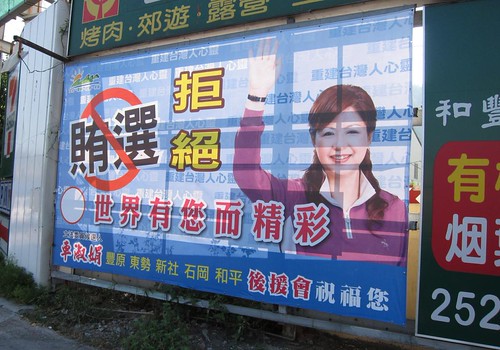
This candidate’s sign says “Rebuilding the spirit of the Taiwanese” and similar sayings on it. The large red characters say something like “the world is resplendent because it has you”. I don’t know whether the saying refers to herself or the voter.

A KMT candidate’s local HQ right in a market in Taichung.

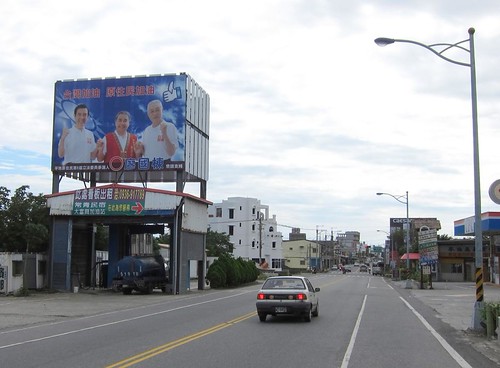
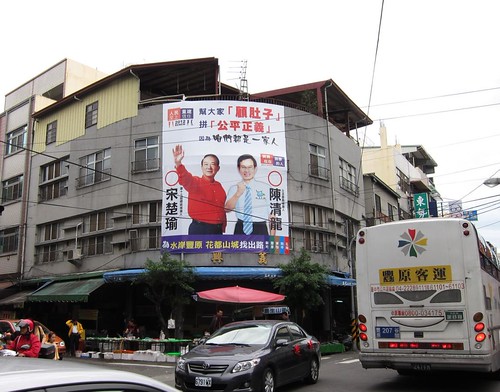
PFP Presidential candidate James Soong (in red), whose candidacy is widely thought to be hurting President Ma’s re-election chances, with a local PFP candidate in Dongshih. The sign calls for fairness and justice in big red letters.

Here’s the same candidate again. That tie is probably the reason he is so thin; can’t imagine how he can eat without getting it in his food all the time.

A small political rally in Dongshih strategically positioned at the end of a bike path.

A van advertises a DPP candidate.

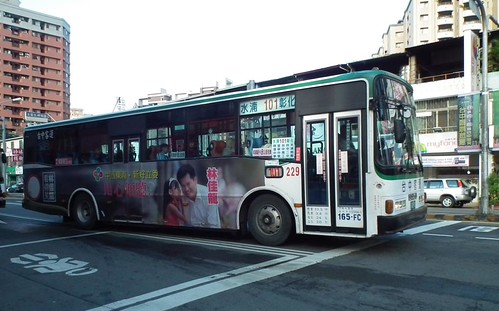
DPP candidate Lin Chia-lung on a bus in downtown Taichung city.

Lin and his wife on another sign.

In downtown Taichung, KMT candidates peer around trees at a major intersection.

This sign proclaims the Facebook address of the candidates. Social networks may reach people, but do they get them out to vote?

Lin again on a sign near the train station in Taichung city. It says he listens with his heart. In the corner it also advertises his Yale PHD.

If you don’t know already, Michael Turton is a Taiwan resident, Doctoral student, and owner of the indispensable The View from Taiwan blog. My thanks to him for bringing this visual feast to the Taiwan 2012 blog. 

The Social Bases of Cross-Strait Policies in Taiwan

Research has shown that Taiwanese opinion on cross-Strait policies is varied, depending on particular issues and social backgrounds. The majority of the population supports economic opening and cultural exchange, but a majority is also opposed to institutional acknowledgement and further social interactions. Individual demographic characteristics and social cleavages, namely, gender, partisanship, and socioeconomic status have played important roles in fostering differing positions and attitudes on cross-Strait policies in Taiwan.

Using data from telephone surveys conducted in 2010, I investigated Taiwanese attitudes towards various cross-Strait policies. The issues under study and the distribution of people supporting and opposing them were as follows:

(1) Economic Cooperation Framework Agreement (ECFA): 45 percent supported and 32 percent opposed

(2) On allowing Chinese students to study inTaiwan: 50 percent supported and 45 percent opposed

(3) On recognizing Chinese diplomas and degrees: 44 percent supported and 50 percent opposed

(4) On allowing self-guided individual Chinese tourists: 43 percent supported and 48 percent opposed and

(5) On increasing the daily quota of Chinese tourists on group tours: 39 percent supported and 44 percent opposed

Overall, apart from the ECFA issue of economic opening, differences of opinion on other policy issues such as educational exchange, institutional acknowledgement and social interaction were around five percent, indicating that there was no common ground on these issues.

There are different social foundations for each cross-Strait policy, sometimes converging, and sometimes diverging. Research indicates that in general men, older people, pan-blue supporters, and people of higher social status were more likely to support the KMT government’s cross-Strait policies. One the other hand, women, younger people, non-pan-blue supporters, and people of a lower social status tended to oppose such policies.

More specifically, the percentages supporting various policies among men and women were:

(1) ECFA, 48 percent vs. 44 percent;

(2) Permitting Chinese students, 55 percent vs. 46 percent;

(3) Recognizing Chinese degrees, 49 percent vs. 40 percent;

(4) Opening to individual Chinese tourists, 50 percent vs. 30 percent; and

(5) Increasing the daily quota for Chinese group tourists, 47 percent vs. 33 percent.

Comparing people of higher and lower social status, the percentages that supported the abovementioned policies among the more educated (college and above) and less educated people (high school and below) were:

(1) ECFA, 58 percent vs. 35 percent;

(2) Permitting Chinese students, 61 percent vs. 42 percent;

(3) Recognizing Chinese degrees, 55 percent vs. 35 percent;

(4) Opening to individual Chinese tourists, 54 percent vs. 37 percent; and

(5) Increasing the daily quota for Chinese group tourists, 46 percent vs. 35 percent.

After controlling various variables, the factor residing in southern Taiwan does not, in fact, have any significant effect on the people’s position on cross-strait policies. On the surface, the influence of party identification on positions regarding cross-strait policies seems to be as expected. Green supporters have a strong tendency to oppose policies towards China. But greens and blues together only make up about 50 percent of the population (Blue 34 percent, Green 17 percent). What is the position towards cross-strait policies within the other half which does not have such a strong party identification? Research shows that, given controlling demographic factors (age, gender, socioeconomic status, and ethnicity), independent voters who were neither blue nor green significantly showed far less support for cross-Strait policies than did pan-blue supporters.

Finally, what merits closer scrutiny are gender differences on support for cross-Strait policies. It was found that, firstly, a higher percentage of Taiwanese women than men opposed increasing social exchanges between Taiwan and China. On the issue of economic opening, there was no gender imbalance. However, on social issues, taking into consideration personal backgrounds (education, marriage, income, and ethnicity), females tended to oppose these issues more than males did. This was much more noticeable among pan-blue supporters. For example, among pan-blue voters only 36 percent of males opposed allowing Chinese students to study in Taiwan, while 64 percent of females did. The same gender discrepancy among pan-blue voters was noted on the issue of institutional acknowledgement and social interaction. Among pan-blue voters 38 percent of males and 62 percent of females opposed recognizing Chinese diplomas. Similarly, 36 percent of pan-blue males and 64 percent of pan-blue females opposed increasing group tourist quotas.

Why were women more likely to take such opposing positions than men for further social exchanges with China? First, it is possibly about the concern over disturbances caused to their daily lives by increased cross-Strait social interactions. Furthermore, the impression of Chinese male chauvinism might well lead many Taiwanese women to mistrust further social interaction withChina. Second, it might reflect the want for stable homes and committed relationships. Many women do not see benefit accruing from further cross-strait social exchanges. In fact, they view closer ties with China in a disadvantageous light and see themselves as becoming potential victims from closer social relations.

These past twenty years have seen Taiwanese businessmen go off to China and send money back home to their wives, who feel alienated as they tend to value marriage, stability and secure homes. This kind of cross-Strait split affects the minority of Taiwanese families today, and the impression it has left on society is very influential. Taiwanese women see a potential threat from Chinese mistresses. The media has recently made a fuss about the “Chinese mistress” effect, which has created a further distrust among women on policies of cross-Strait interactions.

Finally, it may be related to concerns on the impact on the marriage market. Increasing social interactions with China will stimulate the marriage market leaving unmarried Taiwanese women feeling that they are now in competition with Chinese women, placing the fear in the minds of Taiwanese housewives that their children may find matching partners with Chinese youths on college campus. Perhaps as a result of these factors, given the effects of party identification, socioeconomic status, and age, gender on cross-strait social policies remains an independent and significant factor in today’s Taiwanese society.

As the presidential campaign got underway, the KMT government seemed to intentionally downplay cross-Strait social policies as an election campaign issue. Otherwise it would probably not be able to win the support of the majority of voters.

Chih-Jou Jay Chen is Associate Research Fellow at the Institute of Sociology of Academia Sinica and Director of the Center for Contemporary China, National Tsing Hua University in Taiwan.

CCP interference in Taiwanese elections

Ever since Taiwan held its first direct presidential election in 1996, the Chinese Communist Party (CCP) has tried to influence the outcome of elections on Taiwan through implicit and explicit means. Many of you will remember the missile threat authorized by the CCP in 1996. And perhaps too, the harsh warning made by former Premier Zhu Rongji (朱鎔基) during Taiwan’s 2000 presidential election, in which he told Taiwanese voters to “make a historical decision wisely,” otherwise war between Taiwan and China would become a “the logical necessity”.

However, Taiwanese voters seemed to disregard Zhu’s threats and elected the DPP’s Chen Shui-bian (陳水扁) as the president. Since Chen’s rise to presidency, the CCP has modified its means of influencing Taiwan’s politics through subtler ways, mainly by providing incentives for particular politicians, Taiwanese businesspeople, and media, in order to affect and mold the public opinion to create an image in favor of the China. In this post, I will summarize some of the political intentions behind the scenes and discuss how the KMT and the DPP respond to China’s interference.

There is abundant evidence that the CPP attempts to influence Taiwan’s domestic political scene. The DPP recently provided some evidence to support their suspicion of the CCP’s interference in order to help President Ma Ying-jeou (馬英九) be re-elected. DPP spokesperson, Chen Chi-mai (陳其邁) outlined five tactics which China had adopted to ensure Taiwan’s elections would result in President Ma’s re-election. These include sending provincial-level purchasing delegations to boost economic performance, providing incentives to mobilize Taiwanese businesspeople in China to return to Taiwan to vote, allowing the assembly of Taiwanese businesspeople to campaign for President Ma, bribing some particular legislators to influence Taiwan’s policy-making, and hindering other presidential candidates from obtaining political donations from Taiwanese entrepreneurs who are active in China through direct or indirect threats.

Many more examples of such interference have been uncovered by the media. According to a report by Business Weekly magazine, DPP Legislator Tsai Huang-liang (蔡煌瑯) said China permitted Straits Exchange Foundation Chairman Chiang Pin-kung (江丙坤) to brief senior Chinese officials on Ma’s “golden decade” platform at the Great Hall of the People in Beijing on Oct. 28: an explicit signal that Beijing backs Ma. Furthermore, according to media reports, DPP spokesperson Liang Wen-jie (梁文傑) said that Lai Xiaohua (賴曉華), wife of Association for Relations Across the Taiwan Straits Chairman Chen Yunlin (陳雲林), was investigated by the Chinese government for allegedly embezzling USD$300 million, which was listed as “media purchasing in Taiwan.” This outlay was supposed to be spent on “influence” within Taiwan’s media.

Confronted with these accusations, President Ma defended himself in a BBC interview, arguing that these allegations were made up by his rivals and none of them would be able to present evidence reasonable enough to bolster their claims. President Ma further justified his position, proclaiming “is Beijing kind to me, when it has missiles targeting Taiwan?”

The DPP showed the evidence that the CCP aided the KMT and thereby doubting the KMT’s sincerity to put the Taiwan’s interests in priority. While the DPP usually emphasizes on the CPP’s political intention harmful to Taiwan’s sovereignty and security but failed to distinguish the practical matters from political manipulation. From the DPP’s perspective, it seems that anything related to China is dubious and perceived negative. This kind of self-constraint weakens the DPP’s ability to convince people that it can deal with China issues in a proper manner.

The KMT believes that Taiwan can rely on China, and avers publically that politics can be separated from economics. This view is at odds with the CCP’s views on Taiwan, which put politics ahead of everything else. The KMT intentionally downplays the controversy of Taiwan’s national sovereignty and status. It rarely mentions the potential risks inherent in such an asymmetric power struggle between China and Taiwan, as well as the CCP’s insistent denial of recognizing Taiwan as an autonomous political entity.

The gap between domestic political attitudes towards China provides room for the CCP to polarize and divide solidarity in Taiwan and leeway to manipulate Taiwan’s politics. As a result, there is continuing controversy in defining national sovereignty and cross-strait relations, and it seems very unlikely that a consensus will be reached in a short period of time.

The CCP’s interference inTaiwan’s politics is nothing new. While the means of achieving this end have become increasingly delicate, and both carrot and stick tactics are conducted. Although there are various ways of implementation, the logic behind these tactics is the same: to provide attractive incentives for sympathetic elites while threatening and sanctioning troublesome ones. Applying this logic to the context of Taiwan’s elections, the target elites for the CCP include politicians, businesspeople, and the media. The most general tactic is to provide economic or material incentives in exchange for their cooperation. In other words, the CCP intends to influence public opinion through money politics, which can easily affect the outcome of elections, especially when it is linked to gambling behavior common in some electoral districts at the local level.

The CCP’s maneuvers to influence Taiwan’s elections are consistently operating behind the scenes and we should be aware of their methods and resist this interference. The Taiwanese democratic system is a result of many people’s efforts. In order to maintain the Taiwanese democracy, we should not compromise with any force that seeks to harm it.

Muyi Chou is a Ph.D. Candidate in Political Science at Humboldt University of Berlin

Hsiao Bi-khim at Columbia University: report

Ms. Bi-khim Hsiao 蕭美琴, spokeswoman and advisor for the Tsai Ing-wen Presidential Campaign, recently spoke at Columbia University. The event took place on 16 November 2011 and was organized by the Weatherhead East Asian Institute. Ms. Hsiao was invited to speak as a prominent alumna, who graduated with an M.A. in political science in 1995. Political Science Department Professor Andrew Nathan served as the moderator. The venue was filled to capacity with students, scholars, and members of the public. There was a question and answer session following her speech. A number of the questions came from Chinese students who were fascinated to learn more about  Taiwan, their democratic neighbor.

Ms. Hsiao began by discussing her background, simultaneously weaving her own life story and interest in politics into her perspectives on the process of democratic transition and consolidation in Taiwan. Recalling the night when she emceed Chen Shui-bian’s presidential victory rally in 2000, she saw tears in the eyes of older generations of Taiwanese. They had waited their entire lives to change their government through the power of the ballot box. Ms. Hsiao poignantly remarked that following the historic victory, Democratic Progressive Party leaders had to deal with a bureaucracy that formerly saw them as enemies of the state, and had throw a number of them in jail. An opposition party that was born and raised on the streets had to learn how to put its ideals into practice by working within the political system and from the Presidential Palace.

When Tsai Ing-wen took over as chairwoman of the Democratic Progressive Party in May 2008, the party was five million dollars in debt. Many had quipped that the DPP was in the ICU, and Ms. Hsiao said that the process of recovery was difficult and divisive. However, Chairwoman Tsai took a number of steps that enabled the party to once again become a relevant force in Taiwan politics. Her leadership marked a generational change: Tsai was one of the first DPP leaders who was neither politically active during the martial law period nor a victim of political persecution. One of her goals was to encourage the younger generation to help play a leading role in the renewal and regeneration of the party.

Under Tsai Ing-wen’s stewardship the DPP has refocused its attention on socio-economic policy issues, not only cross-Strait issues. It has also sought to win back the public confidence it lost in 2008; Ms. Hsiao noted that in her own mild and moderate way, Tsai Ing-wen has managed to achieve a feat that many had thought impossible. During the November 2010 municipal elections, the DPP won more votes nationwide  than the KMT, despite winning only two out of five mayoral seats. Ms. Hsiao believes that if the DPP wins this election, the party will win on a center-left socio-economic agenda.

Since becoming Chairwoman, Tsai has focused on seeking small individual donations (小募款) and refusing large donations. Ms. Hsiao described how some corporations would attempt to funnel 90 percent of their campaign donations to Chinese Nationalist Party (KMT) candidates, and donate the remaining 10 percent to the DPP. Even such a  relatively small amount of money would benefit the coffers of the DPP, which has always had to compete with a party believed to be one of the world’s wealthiest. However, given the political accusations flung at former President Chen when he accepted corporate donations, Chairwoman Tsai wanted to rebuild the party’s public image as devoted to clean, transparent politics.

In this spirit, the Democratic Progressive Party is currently in the midst of its “Three Little Pigs” fundraising campaign. Ms. Hsiao explained how young triplets attempted to donate money from their piggy banks to Tsai’s campaign, with their grandfather at their side. The KMT protested to the Control Yuan (a government watchdog and one of five equal branches of government in Taiwan), which subsequently ruled that the children’s donations violated the Act Concerning Political Donations because they had yet to reach voting age. Many indignant Taiwanese voters responded by presenting piggy banks full of coins and bills to the DPP. The party began ordering its own plastic piggy banks from the only factory in Taiwan that produces them (the others have moved to China), and tens of thousands of them have been snatched up by party supporters wishing to make donations.

Ms. Hsiao argues that Taiwan is currently standing at the crossroads of a number of policy issues. How will Taiwan deal with security issues, national sovereignty issues, and economic integration with China? She noted that as the debate over nuclear energy continues, the DPP has proposed to invest resources into new energy sectors. Taiwan current operates three nuclear power plans and is building one more. All four plants rest on earthquake fault lines. There is also a renewed interest in agricultural issues in Taiwan. Although production costs are high, the industry creates many jobs. Taiwanese are increasingly aware that as Taiwan moves toward greater economic integration with China, the subsequent economic growth has not benefited all sectors of society equally. Although the Economic Cooperation Framework Agreement has already been signed with China, Ms. Hsiao remarked that if any adjustments need to be made in the future, under a DPP administration they would occur only with the democratic consent of the public via the legislative process. The DPP has previously argued that the ECFA negotiations were not transparent and that the Legislative Yuan was not properly informed during the negotiation process.

The Democratic Progressive Party believes in an activist-oriented approach toward its role in Asia. Ms. Hsiao noted the importance of connecting to the region through democracy. Democracy is not just a moral value, but also a strategic asset for Taiwan, a form of soft power that is critical to its survival. Taiwan needs to not only preserve its democratic achievements, but also consolidate and deepen its gains. Taiwan must continue to find creative solutions to find adequate international breathing room, such as working through NGOs and INGOs. Although Taiwan is already a de facto independent country, Ms. Hsiao asserts that Taiwan seeks recognition. At the same time, she emphasized that Taiwan and China have common interests and can work together without seeking to antagonize each other.

Julia M. Famularo is a Research Affiliate at the Project 2049 Institute and a fourth-year doctoral student in Modern East Asian Political History at Georgetown University. 

Daily shorts Nov 29

Minimalist shorts today (not because Australian Masterchef beckons, but because the candidates are serving up some tasty quotes that work better without my insouciant waffling).

For starters, how about this zinger from Tsai Ing-wen talking about agriculture in the South: Ma “reads the data of his public opinion polls more carefully than economic data.”

Extracted from Time interview: Ma: “Many of my key programs require a long period to be implemented”.  TIME: “Has Beijing given you any indication that it might reduce the number of missiles aimed at Taiwan given the improvement in cross-strait relations?” Ma: “No, they never have”.

Ma has published a book, entitled The Audacity of Hope. Correction, its called Listening and Conversations.

James Soong said something.

KMT’s new campaign slogan “A vote for Soong is a vote for Tsai”.

The KMT website is promoting an editorial from the friendly China Times. “This is the first time in our nation’s history that a sitting President and current Presidential candidate has ever sued his challenger. This is unprecedented. A court battle will become part of the Presidential race”. Um, KMT if you’re thinking of hanging your hat on that, you’re in trouble.

From the same editorial: “Tsai Ing-wen and the DPP are seeking high office. A word to the wise. Voters will not tolerate a political party that fabricates lies to reacquire power”. Must…Resist…Australian…Masterchef…Starting soon…Must Resist…

Mail me at jonathan.sullivan@nottingham.ac.uk, follow me on Twitter @jonlsullivan, or access my papers at http://jonlsullivan.com

Ma Ying-jeou and Ai Weiwei

Ma Ying-jeou spent fifteen minutes at Ai Weiwei’s ‘Absent‘ exhibit at Taipei’s Museum of Fine Art on Friday. Hours before Ma’s visit, I posted this piece by Harry Wu criticising the human rights situation in Taiwan during the Ma administration. In that post, Wu wrote of “the silence of government associated sectors on the persecution of Chinese dissidents, including the vague attitude held by Taipei Fine Arts Museum towards Ai Weiwei’s arrest”. So, does Ma’s visit to the Ai exhibit represent a change of heart or tool for an ailing campaign?

First of all we should recognize that, given the strategic context, this is one of those damned if you do, damned if you don’t moments for Ma. Having made détente with China the cornerstone of his successful campaign in 2008, Ma has had to tread a fine line when it comes to offering support to people and causes blacklisted by China. But this is also an ‘easy issue’ for domestic opponents to attack on, and it is a sphere in which the KMT has its own historical vulnerabilities, so he can’t be seen to be a total walkover either.

Thus the Dalai Lama came to Taiwan (after much oohing and aahing), but was assiduously avoided by officials in the Ma administration. Ma issued a press release after Liu Xiaobo won the Nobel Peace Prize, saying that it was “not only an individual honor but also has great historical significance for the development of human rights in China.” Since information about Liu’s Nobel was put on lockdown in China, Liu Xia has since disappeared and Liu remains in jail somewhere, we can wonder what ‘development of human rights in China’ actually means. Indeed, these sentiments are the same as expressed in Ma’s yearly thoughts on Tiananmen-a fairly safe time to criticize the PRC as it closes its ears to everything outside of China on that day. But lest we castigate Ma too strongly for toeing the line when it comes to China, think of how many other world leaders, CEOs, universities and many others are doing the same.

Ma has mentioned Ai Weiwei, publicly, twice in nearly four years; in his Tiananmen statement in June 2011 and when he visited the exhibit. Speaking to media at the gallery on Friday, Ma spent as much time referencing his Tiananmen statement as saying anything new. The line that 人權保障越接近,雙方距離就能更接近 (the closer the two sides are on protection of human rights the distance between them will decrease) is not new: its essentially the same old ‘when China becomes a democracy etc.’ wishful thinking. The ‘new’ was this: 艾未未是一位藝術家,藝術家應該有表達其藝術觀點的自由,這是臺灣重要的核心價值 (Ai is an artist and artists should have the freedom to express their artistic perspective; this is an important core value for Taiwan).

That is a very clever workaround. As I describe in this paper on Ai Weiwei’s precarious online communities, the cause of Ai’s problems with the Chinese government  is not artistic freedom per se, but the fusion of his art with his activism. But Ma can spin his comments both ways; art as activism for domestic (Taiwanese) critics and “art as art” if China gets upset. It’s interesting that according to observers, Ma avoided “Studies in Perspective”.

Not on Ma's gallery tour

As if there is any other position for him at the moment, Ma was on the defensive at the museum. He first felt the need to explain/justify the reluctance/incompetence of Taipei Mayor Hau Long-bing in failing to invite Ai to Taiwan. He would soon thereafter have to defend criticism that this was simply a 选举秀 (lit. election show). One would like to think that Ma’s support for Ai Weiwei is genuine, and I have no reason to doubt that on a personal level it is. But several things point to instrumental motives.

As documented on this blog, Ma’s campaign is in trouble, and frankly, it needs all the positive distractions it can get at the moment. Taking up a cause celebre that could show Ma as a strong leader not willing to sell-out Taiwan’s core values, seems like a pretty good idea to me. Especially given how the disastrous ‘peace accord’ gambit failed utterly to resonate with voters (indeed, following National Chengchi University’s Center for Prediction Markets, it could be responsible for Ma’s big poll drop through October). And frankly, whatever Ma says during the campaign, China is not going to hold it against him and start wishing for Tsa Ing-wen to win.

Maybe a better test of Ma’s new taste for human rights is to see whether he mentions any of China’s detained rights defenders–who are also emblematic of Taiwan’s core values?

Mail me at jonathan.sullivan@nottingham.ac.uk, follow me on Twitter @jonlsullivan, or access my papers at http://jonlsullivan.com

Refuting the “DPP smear campaign”

Yesterday I wrote that Ma’s campaign is a car wreck and suggested that to get it back on track, his team should get on message, and self-promote and attack on the economy. Instead, they have decided to fall back on a tactic that predates the first presidential election in 1996 and has been present ever since. Namely, invoking the “DPP smear campaign”.

In a troop-rallying speech in Tainan  Ma Ying-jeou “urged party members to be cautious about smear campaigns, while pledging to run a positive election campaign”. Ma argued that “we are facing a tough battle in both the presidential and legislative elections, and our opponents will launch more smear campaigns against us. We should take more cautious measures and prevent such negative campaigning from affecting the party’s performance in the elections”.

I have a paper coming out in January in The China Journal (which I can’t link to yet) in which Eliyahu V. Sapir and I attempt to explain the campaign behaviour of KMT and DPP candidates. I will write a proper post on the findings (which are highly relevant as we move forward in the campaign), but I just wanted to quickly refute the notion of DPP candidates as persistent smear artists.

Using empirical data derived from seven presidential and subnational campaigns between 1996 and 2008, our models provide a robust picture of campaign behaviour in Taiwan. Our findings simply do not support Ma’s (or many of his predecessors’) concerns about DPP skulduggery. In fact, our models show that after controlling for a range of covariates (incumbency, closeness of the race, time to election etc), there are no statistically significant differences between the two main parties in terms of their proclivity to ‘go negative’ or to engage in a certain type of negative campaigning.

There is, however, a statistically significant difference between the parties in terms of what we (euphemistically) call in the paper ‘negative strategic appeals’. This includes the type of claim that Ma made yesterday, and our models suggest this is true to form. Indeed, it is so spot on that I will simply excerpt the relevent paragraph from the paper’s conclusion:

“…use of negative strategic appeals often contain unsubstantiated claims that voting for an opponent will lead to dire consequences (multiple variations of the ‘fear card’), contributing little to the information environment and potentially propagating political mistrust. One of our strongest findings for the KMT is that their candidates’ negative tactics rely heavily on strategic appeals. In many cases (indeed in most of the campaigns analysed in this article) KMT candidates attempted to harness longstanding stereotypes about the DPP by associating vote choice and turnout levels with the purported risks of the DPP coming into positions of power. In addition, KMT candidates frequently associated their DPP opponents with campaign tricks and misleading voters. In our view, this type of claim contributes more to the atmosphere of political mistrust than attacks on the issues or even personal traits, both of which often contain legitimate information about the candidates. We suggest further that legislation is needed to improve this situation, in the same way that Article 48 of the President and Vice President Recall Act forced parties and candidates to ‘stand by their ads’…”

Mail me at jonathan.sullivan@nottingham.ac.uk, follow me on Twitter @jonlsullivan, or access my papers at http://jonlsullivan.com

Human rights and the presidential election

Approaching the Universal Human Rights Month, both the Ma Ying-jeou and Tsai Ing-wen camps are endeavouring to build their own images by presenting their human rights manifestos. The current ruling party KMT announced that it would implement no more executions (literally) of the death penalty before the election: in contrast to the impression it had given the voters previously, concerning its determination to build a powerful judicial system preceded by the standing down of a minister of justice, who opposed the death penalty.

Between 2010 and 2011, nine people were executed, in contrast with the record of the former government. During the Chen Shui-bian years, only two people were executed in the first year of his administration, before the government closed the discussion on this controversial issue.

The human rights records kept by the Kuomintang party have been rarely seen in post-Second World War Taiwanese history. Most of the records show inappropriate arrests and confinements of innocent individuals during the Martial Law period. The rise of the DPP was closely associated with its concerns for the weak and marginalized. Under the DPP rules, nevertheless, the government did not reach any significant achievements in the area of transitional justice apart from restoring the reputation of former political prisoners. The steadfast structure of government administration remained untouched; the reformation of judicial and taxing systems was not complete. The rights of indigenous populations, gender minorities and new immigrants were not satisfactorily regulated.

Since the KMT came to power again in 2008, Taiwan’s human rights record deteriorated, due to the government’s honeymoon relationship with China. The clashes between police and activists protesting Chinese envoy Chen Yunlin’s visit in November 2008 and the consequent events were seen as an indicator of dwindling freedoms of speech, assembly, and the press freedom. In 2010, when Liu Xiaobo won the Nobel Peace Prize, Taiwan’s government failed to condemn China’s human right violations soon enough to meet the pressure of public opinion. The newly created Presidential Office Human Rights Consultative was seen as a delayed response to balance the criticism.

The honorary chairman of the KMT, Lien Chan, being awarded the inaugural China Confucius Peace Prize was another embarrassing moment (this year’s winner, Vladimir Putin). The silence of government associated sectors on the persecution of Chinese dissidents, including the vague attitude held by Taipei Fine Arts Museum towards Ai Weiwei’s arrest, all make the promise of the current ruling party to pursue principles of human rights unconvincing and doubtful.

The recent maid abuse case involving Liu Shan-shan, the representative of Taiwan’s Kansas Office, again challenged the extent to which the Taiwanese government respects human rights in comparison to diplomatic immunity. This puzzle, however, does not only confront the KMT government, but the entire Taiwanese society. There are too many topics that are seldom discussed and underplayed not only by the government, but also the general population, due to the exhausting political contest between blue and green. There is still a general acceptance of the death penalty. The discrimination of minorities persists. Capitalists’ exploitation of labourers still plagues the labour market.

One view as to why Taiwan’s progress towards a “normal society” remains unfulfilled, is the possible collective mentality resulting from the long authoritative regime. People do not see the subordination to authority as an evil but only banality. They think that one should envisage the future instead of looking at mistakes made in the past. Therefore, the general public are indifferent regarding most of the unfair treatments in their daily life. They are also ignorant in most aspects of legal life. For example, in the recent restored injustice case of Jiang Guo-qing, an innocent soldier tortured and eventually gunned down by the military, the state only reimbursed the bereaved family without paying indemnity. Most of the public, including the press, do not understand the different nature between these two forms of compensation.

In November,  Human Rights We Care (台灣大選人權陣線), a league comprising thirteen NGOs, was formed to monitor the human rights manifestos of all presidential candidates. It has issued a questionnaire for all candidates to clarify the content of their human rights policy. Judging on the performance of two ruling parties in the past decade, the government’s actions were always sluggish and passive. The vast and unshakable system of government, which was left behind by the past regime, seems to be the main obstacle. If current KMT government cannot live up to its advantage in developing a small and powerful official procedure, but instead designs the structure of the public sector according to its obsessive desire to connect with China, which is already happening, then the reformation of human rights in Taiwan will be always hampered by its own bureaucracy, and will have to perpetually rely on the slow growth of civil society.

Harry Yi-Jui Wu is a DPhil student at the Wellcome Unit for the History of Medicine, Oxford.

Daily shorts Nov 24

Dear KMT, is anyone over there driving the bus? Why are you allowing Ma’s campaign to get continually sidetracked by extraneous fluff that at best would be a two day talking point? Right now you are single-handedly giving Tsai’s (deliberate and effective) low-key campaign the buzz it needed going in to ‘rally month’. As a political scientist who studies strategic behaviour, Ma’s campaign is exasperating. If it keeps going like this, I’m going to have to reserve a chapter in the book I’m writing on Taiwanese elections on ‘how not to run a campaign’.

Nobody cared about the piggybanks until you made a big deal out of it. Tsai is Hakka, why shouldn’t she appeal to that constituency? Tsai is popular with Hakka voters, and you’re not going to endear yourself by questioning her Hakka identity. So what if Tsai wants to be Robin Hood–if Robin Hood himself was standing for election do you think he would win? Do you really think filing a lawsuit against the DPP for allegations about the propriety of Ma’s meeting an oddsmaker will make it go away? Don’t you think it might make it more salient instead? Don’t think it’ll remind voters about the bad old days of heijin and using litigation to curb freedom of speech? Flip-flopping on farmers’ subsidies does not say “I’m in charge, I’ve got a plan, trust me” (albeit adopting a more viable position on a highly salient campaign issue). And that ‘peace pact’ gambit speaks of someone out of touch with public opinion and desperate seeking a keystone campaign issue.

I wrote a while back that KMT candidates always want to campaign on the economy but invariably let themselves get sidetracked; I guess I should be grateful that Ma’s campaign is making me look good. I don’t know if it is a sign of desperation, incompetence or hubris, but when your own legislative candidates are steering clear of you, its indicative of a problem. And when your campaign manager starts talking up your EQ, you know you’re in trouble.

Can Ma turn it around? Of course. The election is not for another 7 weeks-an eternity at the back-end of a campaign. But the way things are going, those 7 weeks must seem like an unending and terrifying gauntlet to Ma right now. Furthermore, Tsai Ing-wen is a careful and clean candidate, and I doubt there are any Chen You-hao’s hiding in her closet to come to Ma’s rescue. Is it too late to register a Ma-Soong joint ticket? (Just kidding).

Alex Huang says Ma should ignite a grassroots campaign by “sleeping less and shaking more hands“, but I don’t think that’s the answer. As charming as Ma can be on camera, KMT elites don’t do “smalltalk-with-little-people-in-crowded-smelly-markets” very well. Remember when Lien went to visit with emotional (and muddy) typhoon-affected villagers in 2000? When people started imploring him to send aid he reacted like someone took a dump on the 18th green right before his putt. This Soong ad in that vein (don’t forget hand-hygiene kids) has the added bonus of ‘Soong as Savior’.

In my view, a better strategy is to forget China, eliminate all the extraneous frippery, develop the ‘KMT are good stewards of the economy’ frame and attack Tsai’s plans for the economy. King Pu-tsung, you know what to do…

Mail me at jonathan.sullivan@nottingham.ac.uk, follow me on Twitter @jonlsullivan, or access my papers at http://jonlsullivan.com

Will the DPP experience a Paul V Kane boost?

The now-infamous opinion piece written by former marine officer and Harvard scholar Paul V. Kane, “To Save Our Economy, Ditch Taiwan” (New York Times, November 10, 2011) which advocated a renunciation of the US security commitment to Taiwan in exchange for China’s writing off US debt is, quite rightly, engendering serious blowback. So much so that it may in fact have the opposite effect for which Kane (and no doubt the leadership in Beijing) initially hoped.

For months now, think tanks and academics have tiptoed around the very same idea: that of revisiting the US defense commitment to Taiwan in favour of giving Beijing a louder voice in how it is implemented.

But Kane’s piece has been far less oblique than these others, laying bare the ethical component of their inherent quid pro quo. The result has been a widespread re-examination of just why the United States made a security guarantee toTaiwan in the first place, and forcing a reckoning of just what moral implications such an exchange would entail.

Moreover, the notoriety of Kane’s suggestion has allowed it to reach beyond the usually insulated world of analysts and policy wonks, and touch upon the general public. It has shined a light on the issue and dragged it to the forefront of popular discourse.

To be fair, Kane’s timing was off. Americans are getting tired of China. The much ballyhooed peaceful rise has been trumpeted in every media report and press briefing for the past decade, and the unspoken assumption that American power in the world is declining in favour of a passing of the torch to China has been allowed to suffuse the popular imagination without much introspection or challenge. Kane’s rather mercenary proposal has laid bare the ethical aspect of that slide, and it may well prove to be the straw that break the panda’s back, illustrating just how far the partnership with China has slowly and incrementally pushed Americans’ moral comfort zone over the years.

It is therefore not surprising that the reaction has been a loud rejection of any plan that would hand a functioning democracy over to an authoritarian government, especially in exchange for something so vulgar as money. Americans instinctively feel that this would leave a stain on their souls.

How does this affect Taiwan? The people, as well as the government, of Taiwan are almost pathologically fixated on what is said about them in the international arena. Thanks to Kane, many column-inches are now being filled by Western commentators expounding on the moral issues associated with selling out a longtime friend and ally, in a way and with a determination that has not been seen for years.

Many Taiwanese are naturally heartened by this: they are proud of their democracy; they have fought for it, and bled for it. They know, however, that they are in a fragile position, and being the pragmatic people that they are, they know that they cannot defend it (either militarily or diplomatically) without the United States in their corner.

Over the past few years, the narrative in the mainstream American media has been about how expensive the Taiwansecurity guarantee is, and how the little island democracy is an irritant to closer Sino-US ties. The Taiwanese have naturally begun to hedge their bets. This has been one of the reasons for the level of support shown to Ma Ying-jeou’s China-friendly policies and the resurgence of the old-guard way of thinking within the KMT.

This resulted in a redefinition of the status quo over the past few years: from one that was inching towards independence to one that is inching towards unification.

But as American voices backing support for their democratic ally have become louder in the past days, the Taiwanese confidence in being able to resist the slide into the PRC’s sphere have likewise gained traction. Many undecided voters are beginning to calculate which of the island’s two main parties is best able to maintain the status quo that they most hope to see: and that party is the DPP.

It is too early to see any of this is reflected in the polls, especially as its effects would be obscured by the many other issues defining the campaign so far, not least of which are some very poorly thought-out, ill-timed statements by the incumbent KMT. But if the fallout from the Kane proposal continues to loudly support the American value of respecting allies over money, and democracy over expediency, then we can expect to see a heartened and confident electorate go to the polls in January in support of the DPP candidate, Tsai Ing-wen.

Dean Karalekas is a researcher at National Chengchi University and a PhD student in its International Doctoral Program in Asia-Pacific Studies. 

Forecasting the Legislative elections

Watching Taiwan’s forthcoming elections from the vantage point of London, it does seem like the presidential election is the only campaign taking place.  The vast majority of both the Chinese and English print media coverage is concentrating on the struggle between Ma Ying-jeou and Tsai Ing-wen. The simultaneous legislative election in contrast is being largely neglected by the national media. As I have written in the Taipei Times, this is problematic from a perspective of democratic accountability. Under authoriritarian rule Taiwan’s parliaments were largely rubber stamp institutions. This is no longer the case in democratic Taiwan. The outcome of the Legislative Yuan election is as important if not more so than the presidential one. Without legislative majorities presidents are forced to either compromise with the majority party or face severe constraints, as the saw under the DPP era.

What are the prospects of these partly forgotten elections? Firstly, we can rule out a repeat of the Kuomintang’s (KMT) landslides of 2008. On that occasion the KMT with its allies won three quarters of the seats on only about 50% of the vote share. It is also unlikely that the DPP would be able to cobble together even a wafer thin majority.

Looking through the 73 district races it seems to me that we can divide them into approximately a third which the KMT should win, another third where the Democratic Progressive (DPP) has a clear advantage and then a final third which could go either way. These swing districts are likely to determine whether the KMT is able to win a workable majority or will be reliant on the allies of questionable reliability, such as the Non Partisan Alliance and Soong Chu-yu’s People First Party (PFP). Based on my initial predictions we may get see the KMT getting 40 district seats and the DPP 33. If they both gain 17 proportional representation (PR) seats each and the KMT and its allies win all six aboriginal seats, then we could get a Legislative Yuan with 63 KMT (including its allies) and 50 DPP seats. If we consider that in 2008 the DPP won a mere 13 district seats and 14 PR seats, then the DPP would be almost doubling its seats. Such a Legislative Yuan would offer genuine constraints in Ma’s ability to dictate legislative politics.

What about other parties you are probably asking? These KMT totals include some seats for its allies. Thus for instance up to three Non Partisan Alliance candidates have a strong chance of winning, as does the one NP candidate, and also 3 PFP district candidates have a fighting chance of success. In 2008 the NP came the closest of the smaller parties to winning seats through the proportional district, gaining almost 4 percent vote share. However, this time I can only see the PFP having a chance of passing the 5% threshold, largely as a result of benefitting from Soong’s presidential campaign.

Why is the outlook looking so different from 2008?

One variable that should favour the KMT is that it has an overwhelming incumbency advantage. IN contrast four years ago there was a rough balance between Pan Blue and Pan Green incumbent legislators. Back in 2008 the two elections were separated by three months, with the legislative contest in January and presidential one in March. The KMT’s landslide legislative majority in January gave it a significant momentum for the March presidential campaign. In 2012 the two elections are being held simultaneously. The KMT’s motivation was to enable its legislators’ vote mobilization to benefit its presidential candidate, while the DPP hopes for the reverse whereby a strong Tsai campaign will lift DPP legislative prospects. I am not sure who is right and there may well be regional variation in the effect. However, we can be sure that the voter turnout should be raised for the legislative election compared to 2008.

Back in 2008 KMT legislative candidates rode on the back of Ma’s presidential campaign, but after almost four years of the Ma presidency many KMT legislators no longer view him as helpful for their re-election drive. Another major shift in the public mood is the disappearance of Chen Shui-bian from the agenda. In 2008 many voters (Blue and swing) viewed the elections as a chance to punish the DPP and Chen Shui-bian for the string of corruption scandals that emerged from late 2005. This issue has almost faded away today. Even the candidacy of Chen’s son in Kaohsiung 9 has only created limited attention. While it is possible that Chen Chih-chung will split the Green vote sufficiently to allow the KMT to win that seat, his campaign has not generated much momentum yet or had any spill over effect beyond the district.

Under Tsai the DPP has created a sense that the party has put the Chen Shui-bian scandals behind it and recovered. This has been apparent in its improved performances in 2009 and 2010 local executive and city/county council elections. In 2010 executive and council elections the two main parties were essentially tied. That in itself represents an achievement for the DPP which had seemed down and out between 2005 and late 2008. One of the most remarkable developments in terms of legislative elections since 2008 has been the 12 legislative by-elections caused by resignations and corruption cases. The DPP won nine of these, including six which had been won by the KMT in 2008. The DPP also won in places such as Taitung and Hsinchu County, where in past it had sometimes not even bothered to nominate candidates. Naturally we need to be cautious about how we treat by-elections and it is quite possible that the KMT will regain control over some of these lost districts this time.

Another major difference between 2008 and today is in the field of nomination. In 2008 problems related to both presidential and legislative nomination served to create severe internal tensions within the DPP and undermine their campaigns. This time the process though less democratic, has gone much more smoothly. As far as I am aware there are no real DPP rebels proposing to stand against official DPP candidates and the party is looking much more united. At this stage it does appear that there are more potential KMT rebels threatening to stand and divide the KMT vote than in 2008.

A final area where the campaign looks very different is in the role of third parties. In 2008 the TSU took potential DPP votes in the PR section and also served to split the Green votes in many district races. This time the TSU will not nominate district candidates and has been weakened after four years out of parliament, so that it is unlikely to get more than 1-2 percent in the PR vote. In contrast the PFP is likely to have about a dozen district candidates; these will split the Blue vote in some districts. Both the NP and PFP will also take PR votes from the KMT. Lastly, in 2008 there was a plethora of other small parties contesting the PR vote section. Although they failed to get any seats or even get more than 1 percent, they did take votes away from the mainstream parties. This time there is less enthusiasm to contest this election from small parties that are not splinters from the KMT or DPP. Of these challenger parties, perhaps only the Green Party will exceed 1 percent.

I will try to write something that looks at the districts and offers some more detailed predictions later. It is best to wait until legislative registrations are completed at the end of this week. There will be much pressure applied and money spent in the next few days to persuade rebels and allied party candidates not to stand. There will probably be some surprises too.

Dafydd Fell is Senior Lecturer in the Department of Politics and International Studies at the School of Oriental and African Studies. His new book is entitled Government and Politics in Taiwan.

Daily Shorts Nov 21

The presidential campaign is still young, but there have been numerous mis-steps already. Haven’t been keeping count? Ben Goren has, and he reckons its KMT 7 : DPP 1 (but remember that incumbents get lumped with anything that goes wrong in government). Ma is also unhappy with Tsai being labelled “robin hood”: “The Robin Hood that I know was chivalrous and robbed the rich to give to the poor. He did not tell lies to blacken the name of others.” Tsai’s response “Only a person who wants to oppress the people would be afraid if Robin Hood appeared. Robin Hood would be a thorn in his side” I feel another KMT misstep coming…

The BBC‘s Chinese service will interview Tsai Ing-wen on November 24, and Soong the day after. Bloomberg is on the case too; here’s their interview with Tsai. Michael Turton attended the opening of Tsai’s campaign HQ in Taichung, and comments that “the little rally was strictly by the numbers, professional, bland, but effective, like the campaign. Very pleasing to witness. The DPP is running a much better campaign than the KMT this time around, so far.” I totally concur. And if it were an even playing field, I’d say that it augurs well for Tsai. But it isn’t an even playing field. As an incumbent, Ma has substantial campaign advantages, some of which are true of all incumbents, others particular to the situation in Taiwan. Tsai’s demeanour is the perfect antidote to those who would fear DPP “extremism” or “ideologues”. But is the quiet, rational approach sufficient to make the case for a change in the status quo (i.e. Ma as president)? Maybe this is why the DPP plans 30 mass rallies in the run up to the election.

Zaoshi is important, but if the KMT keeps running Ma’s campaign the way it is, it won’t be necessary. I wrote the other day how KMT presidential candidates are always getting sidetracked. I don’t have an explanation for why, but there are a few potential factors. The KMT is a catch all party with fingers in many pies and DPP candidates are able to draw on a substantial history of KMT governance. The DPP is effective at using this in its attacks, frequently inducing the KMT to respond (indeed, one of the outcomes of Taiwan’s intense media coverage, is the high level of “responsiveness” that one sees during campaigns). The problem for the KMT is that with so many interests and so much media coverage, an effective opposition can quite easily force them off message. There are already numerous examples for this campaign (see KMT 7: DPP 1 above), to which we can add the rumours that Ma met with a gambling tycoon. Tsai of course demands that Ma comes clean over his meeting with said tycoon while one KMT official offers $10 million for proof. These rumours and rebuttals are another example of how “shit happens” to KMT candidates, and how it forces them to spend time and money addressing issues that it doesn’t want to.

Mail me at jonathan.sullivan@nottingham.ac.uk, follow me on Twitter @jonlsullivan, or access my papers at http://jonlsullivan.com

Sun Yat-sen and Ma Ying-jeou in Taiwan 2012

Celebrations of the Xinhai Revolution, that is, the uprising against Manchu rule that occurred in China over 100 years ago, have been taking place on both sides of the Taiwan Strait. ForBeijing, the Republic of China expired in 1949 and is therefore history but inTaiwan, the question of whether the ROC still exists on the island is still a topic of intense debate for the diverse political camps. Against this background, in view of the approaching presidential elections, it is hardly surprising that the ROC centennial celebrations have once more drawn attention to the island’s national identity problems.

For the Kuomintang, the Republic of China is still alive and flourishing although the KMT has acknowledged in some ways that the ROC today consists of Taiwan and some small islands: “the ROC is our country, and Taiwan is our home” was the proud announcement of the current president, Ma Ying-jeou.

The centennial celebrations provided Ma Ying-jeou and the KMT, now returned to power, with the opportunity to reclaim legitimacy with a smoothly polished version of the historical events of 1911-1912 that dovetails neatly with the current political discourse on the modernization ofTaiwan. This, linked with the democratic achievements after 1987, can be used to legitimize the rule of the KMT, today and in the past. In addition, attacks on the so-called de-sinification and Taiwanization movement promoted by the DPP can also be found within this discourse. Examples of this new legitimization discousrecan be found not only on the President’s website but also in almost all the publications issued by the pan-blue camp (including political parties such as the KMT, PFP, NP and media such as the United Daily New China Times, TVBS).

The difficulties inherent in formulating an argument against any 100 year celebration of anything meant that both the oppositional camp and the presidential candidate, Tsai Ing-wen were reluctant to challenge the celebrations. Some DPP-inclined academics, of course, emphasized the fact that the ROC government in Taiwan is a “regime in exile” and criticized any attempt to link the Wuchang uprising, that took place, when Taiwan was a Japanese colony, to the current democratic achievements in Taiwan. In contrast to the KMT, which sees Taiwan’s democratization as the fulfillment of Sun Yat-sen’s heritage, these critics regard these democratic achievements as having been fought for by the people of Taiwan against the authoritarian rule of the KMT, and as leading to the lifting of Martial Law in 1987, the direct election of a President in 1996 and the changeover of power to the DPP in 2000. For them, democracy has been achieved by attacking the legitimacy of the ROC and not by adhering to Sun Yat-sen’s ideology of the Three Principles of The People. Nevertheless, in order to win the support of the median voters, Tsai Ing-wen, the DPP’s presidential candidate who, in the past, avoided taking part in any centennial celebrations and was known for her avoidance of the words “Republic of China/ROC” has recently softened her stance: last month, she made a statement “Taiwan is the ROC, the ROC is Taiwan,” thus allowing for comparisons to be drawn with statements made by the former President, Chen Shuibian.

In state sponsored publications (such as Bainian Fenghua) today, Ma Ying-jeou seems to be regarded as the President of the ROC who has finally fulfilled the dream of Sun Yat-sen, the “Father of The Republic”, (a title that Sun was only given in 1940). For the pan-blue camp, the thoughts of Sun Yat-sen paved the way for the evolutionary development of democracy (tutelage) and also helped to develop the economic system (the ‘economic miracle’ in Taiwan). Furthermore, as a respected figure in all Chinese regions (probably with the exception of broad areas of Taiwan), Sun Yat-sen can lend legitimacy to the KMT’s representation of all Chinese worldwide.

How will this KMT disocurse be accepted within Taiwanese society? Unlike Chiang Kai-shek, who is portrayed as the cruel ruler who implemented the White Terror of the early ROC rule over Taiwan, Sun Yat-sen is not considered to be of any importance for Taiwanfrom the perspective of the pan-green camp. They emphasize the fact that Taiwanwas a Japanese colony in 1911 and 1912 and that Taiwanwas spared the chaos of the Warlord Period following the Xinhai Revolution. In addition, after 1949, the Three Principles of the People were misused: the frequent references to the Three Principles formed part of the policy of the authoritarian regime and for this reason, they are no longer taught in Taiwanschools and do not form part of the university entrance system. Even in the context of democratization, Sun Yat-sen did not play any role in Taiwan: the earlier attempts of liberals such as Lei Zhen (Lei Chen) and Yin Haiguang failed to establish democratic structures in Taiwan, in contrast to the successful indigenous democratic movement after the late 1970s.

It remains to be seen whether the recent focus on the 100 years of the ROC will continue to exert an influence in the long-term, considering the many inherent contradictions and the obvious attempts to create a coherent history which does not have any foundation in fact.

Dr. Jens Damm is currently on sabbatical from the Institute of East Asian Studies at Freie Universität Berlin and is serving as Assistant Professor at the Graduate Institute of Taiwan Studies, Chang Jung Christian University.

Implications of the 2010 Municipal Elections for the 2012 Legislative Elections

Political scientists have at least three reasons to eagerly look forward to the 2012 presidential and legislative elections in Taiwan. Firstly, it will be the second time under the new electoral system, wherein the Legislative Yuan (LY)  has move from the Single Non-Transferable Vote-centered (SNTV) system to a mixed one with the majority of deputies elected through single mandate FPTP districts (73 out of 113, or 65%). It will be interesting what lessons the parties have learned from previous elections, if any at all. Secondly, for the very first time both major elections will take place on the same day. Thirdly, elections in Taiwan draw a lot of excitement in any case.

This post offers a few observations from the 2010 municipal elections (with emphasis on mayoral elections) and their implications for the forthcoming legislative elections. The significance of municipal elections in 2010 stems from the high voter turnout. In total, more than 7.5 million people (turnout exceeded 70% in all 5 districts) cast their votes in 4 newly formed special municipalities (New Taipei City, Greater Taichung, Greater Tainan and Greater Kaohsiung) and in Taipei City. This is an impressive number considering that the turnout for 2008 presidential elections was 13.2 million people (76.3% turnout) and 10 million for the 2008 legislative elections (turnout slightly over 58%).

Results in 2010 appear at first sight to reveal a Kuomintang (KMT) win. If looked at as a football match then victory was narrow, KMT defeating the Democratic Progressive Party (DPP) 3:2. Yet, a more detailed look shows that the KMT camp had no reason to be overly excited. On a city council election level the match was tied since both big parties gained 130 seats.  However, in council elections representatives of smaller parties and independents usually score better than on the national level as the current electoral system to LY is massively disadvantageous for small parties. This makes these results less relevant compared to mayoral elections that were to a large extent 2-party business and one can reasonably predict that it is what LY elections will look like.

The real difference comes with the number of votes in the mayoral elections. The KMT got 3.37 million (or 44.5%) votes, while the DPP received 3.77 million. (or 49.9%). Just a quick look at the 2008 election results shows the extent of change in DPP’s electoral performance. In the 2008 LY elections the DPP received roughly 3.8 million (or 39%) votes and only 24% of seats (disproportionate effect of the newly enacted system) compared to KMT’s 5.3 million (or 53.5%) votes which secured them 72% of the seats.

A further look into each of the 5 districts reveals that Taipei remained strongly blue (KMT 55.7%, DPP 43.8%) and Tainan (KMT 39.6%, DPP 60.4%) and Kaohsiung (KMT 20.5%, DPP 52.8%) confirmed their status as pan-green strongholds. However, the KMT had to undertake fierce battles to claim victories in both Taichung (KMT 51%, DPP 49%) and New Taipei City (KMT 52.6%, DPP 47.4%). This means that the Kuomintang scored more goals but their possession was unimpressive, while the DPP’s forwards pressed hard into the KMT’s defense. Surely, goals are what matters the most in a football match, but it would be a huge mistake to become complacent after such a narrow contest, especially when the main rival is on the rise.

The overall message is clear: last year’s elections confirmed that the Democratic Progressive Party (DPP) is back in the game as a formidable challenger to the Kuomintang’s position and has moved on from the 2008 debacle. At the time this was written, National Chengchi University’s project Exchange of Future Events was predicting that the KMT will eventually win 60 seats (or 53%); less than the 81 held after 2008 but still a majority.

Michal Thim is currently enrolled in the International Master‘s Program in Asia-Pacific Studies at National Chengchi University in Taipei and research fellow at the Prague-based foreign policy think tank, Association for International Affairs.

Daily Shorts Nov 18

Remember that Kane op-ed in NYT last week? The one that he’s been ridiculed for ever since? Turns out it was just an exercise in “Swiftian satire”. Just that no one found it very funny, except for Kane himself: “What is hilarious is that some academics in Taiwan and elsewhere stayed up late at night reading the piece literally and trying to build cases to refute its content, and castigating my logic and morals… Take your wife out to dinner!  Professor or Joe Blogger, it was time miss spent.” Its OK, Paul, I get paid to do this shiz (just not enough to take my wife out to the restaurants she likes).

Accusing Tsai of being a ‘fake Hakka’ because she doesn’t speak the language was crass and potentially damaging, especially given KMT language policies during the one-party era. So Ma quickly rolled out two ads, both apparently featuring language teachers exulting Ma’s serious attitude toward language acquisition. The ads are redolent of the ‘testimonies’ CSB used in 2000, in which school teachers, classmates etc. from the Tainan countryside (and a Nobel prize winner) testified to his good character, as part of the ‘CSB isn’t a madman who is going to declare independence’ cycle of ads. Ma needed a response, because this is the type of thing that could easily spiral out of control and mess up the campaign agenda (KMT peeps: remember the economy!). Tsai doesn’t want to initiate a big fight over identity, but something like this could be another gift horse (without the piggy-banks how much less buzz would Tsai have right now?). I’m not at all surprised that Ma wanted to nip it in the bud, but I predict that these ads won’t achieve that.

In these ads we’re asked to picture Ma as a great student–I don’t doubt he is–resonant in Taiwan where a substantial proportion of people spend a lot of time learning languages. We are shown the testimony of venerable teachers (Taiwanese respect teachers right?), who also happen to represent the ethnic groups Ma wants to appeal to (so, doubly effective right?). We’re told that learning the language is Ma’s way of showing respect, not just a tool for vote-getting (a charge that has been levelled at DPP candidates for many years re: Hakka voters). Personally, I look at these ads and think, ‘I can believe Ma is decent, earnest and a terrific student’. But, so what? You (not Ma personally, but his lieutenant) questioned someone’s identity (in a polity where identity is an ultra-sensitive issue and one on which the KMT is hugely disadvantaged) on the basis of something your party was largely responsible for. That doesn’t go away just because Ma looks like he gets straight A’s.

There is quite a bit of research in political communication on the effect of politicians’ looks, voice, body language etc. on voter attitudes. This latest piece just came out, and it supports what we already know: good looking people do better in politics. There’s also evidence, in a variety of contexts using experimental and real world designs, that men with deeper voices and more muscular frames do better, and that the effect of physical looks is more pronounced for women than men candidates (you guessed that last one, right?). I hadn’t considered this in the case of Taiwan2012, until I came across a recent SCMP article (sorry no link, but its “Tourism conquers the great divide” by Lawrence Chung, Oct 1 2011). The article itself is a bit of frippery about tourists from China marveling at Taiwanese freedoms, but it goes on to quote a Chinese student at NTU as saying: “Oh, Ma Ying-jeou is very handsome and very gentlemanly, while Tsai Ing-wen is very smart and sharp.” Personally I think this is an election for someone who is smart and sharp (handsome is an irrelevant quality when it comes to fixing the economy), and I think Ma will downplay the looks card. Attacking Ma for being an ineffective show pony has been a staple in DPP ads for years–I remember Li Ying-yuan in the 2002 Taipei Mayor race had a great line (from memory) “再怎麼帥,不能這麼草率” (no matter how handsome you are, you can’t be this slapdash). Didn’t help Li, but Tsai will use similar.

Finally, Sigrid Winkler, who posted here a couple weeks back, has a new piece out at Brookings on “The Challenge of Taiwan’s International Status”.

Mail me at jonathan.sullivan@nottingham.ac.uk, follow me on Twitter @jonlsullivan, or access my papers at http://jonlsullivan.com

Daily shorts Nov 17

The campaigns are heating up. How do I know? Chao Li-yun has drama, somebody sees Beijing’s fingers making mischief, the presidential debates schedule is out and the parties are hawking stuff to raise funds. Still need convincing?

You want issues? Tsai is offering to protect animal rights (and boy could Taiwanese animals use a break). On animal protection she says “ask why the government spends so much money on fireworks displays, instead of asking why we should spend so much on protecting animals”. Alas, the animal activists quoted here will still vote Ma because of his cross-strait policy—because they treat animals so well in China obviously [see comments below]. Ma is going after the education vote, while the DPP promises free health insurance to seniors on the offshore islands (not sure how big or influential that cohort is, but that’s the ‘a prize for everyone’ mentality of campaign season). Ma campaign says they’re going to focus on the economy, but KMT candidates always set out to campaign on the economy, and they almost always get sidetracked. For example, when you think of the Lien-Soong ticket, I bet you think personal attacks, anti-referendum, kissing asphalt due to a surfeit of Taiwan love. What they actually wanted to do was focus on the economy. Something will come up and the KMT campaign will go off message.

You want foot in mouth? KMT calls Tsai a “pseudo Hakka” because she can’t speak the dialect. After many of those guys put so many hours in with the lingua-phone learning campaign phrases in min nan, Hakka and native languages, you didn’t think they’d let this go did you? But it made it rather awkward when the Hakka Society reminded the KMT of the KMT’s policy of suppressing non-Mandarin languages during the one-party era (when Tsai grew up). Wu Poh-hsiung said Tsai Ing-wen had tried to “swindle Hakkas into voting for her” with just a few broken Hakka sentences. There is a very serious issue here, but is Wu really daring me to post video of [insert any number of KMT candidates past and present] speaking contemptibly bad [insert non-Mandarin language] in order to appeal to various ethnic groups?

Yes, campaign season is upon us (and its official, we have a three-horse race for president)

PS Remember that NYT op-ed? Want to see how Paul V Kane (or his PR) described it? From the man’s FB page, I quote “Kane discusses U.S. national security and with a provocative blend of irony, facts, Swiftian satire and seriousness – – the importance of “economic security” over military might, and he makes a modest proposal on how to leverage Taiwan with China to eliminate American debt and reduce the risk of a Sino-American war.”

Mail me at jonathan.sullivan@nottingham.ac.uk, follow me on Twitter @jonlsullivan, or access my papers at http://jonlsullivan.com